fundamental analysis

Sunday, September 8, 2019

Euro Gaps Lower vs British Pound Ahead of ECB, Brexit Volatility

Brexit, Euro, GBP – TALKING POINTS
  • Euro, GBP brace for Brexit volatility as government flounders
  • Bare data docket leaves traders focusing on fundamental risks
  • Euro volatility may be curbed by upcoming ECB rate decision
Learn how to use political-risk analysis in your trading strategy!
The British Pound and Euro will likely find themselves being torn by Brexit-related volatility amid a bare data docket. A report by The Telegraph recently stated that UK Prime Minister Boris Johnson is looking into legal ways to circumvent a law that was passed in Congress last week that compels him to request a three-month Brexit extension by October 19 if he is unable to reach a deal by that point.
However, given the state of UK politics, it is difficult to say with confidence that the government has secured a unified position on the matter. 21 conservative lawmakers have been expelled from the party after they supported a bill that rejects a no-deal Brexit outcome. Others have defected or resigned like Pension Secretary Amber Rudd who’s scathing message to the Prime Minister sent out a political shockwave.

EUR/GBP TECHNICAL ANALYSIS

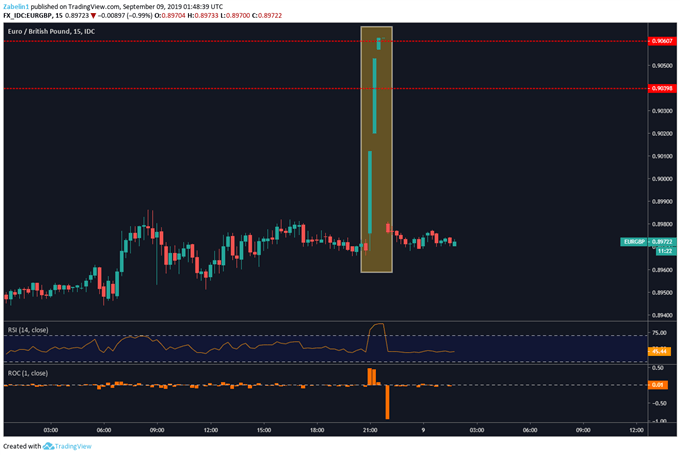
Heading into Sunday’s session, EURGBP gapped lower along with other Euro crosses. A possible reason behind the price move may be due to the expectation that the ECB will deliver aggressive stimualtive policies market participants have been pricing in. These include a rate cut and the reintroduction of QE. However, EUR/GBP’s decline may be reversed if the ECB is not as dovish as investors hoped it would be.
EUR/GBP Gaps Lower
Chart showing EUR/GBP
EUR/GBP chart
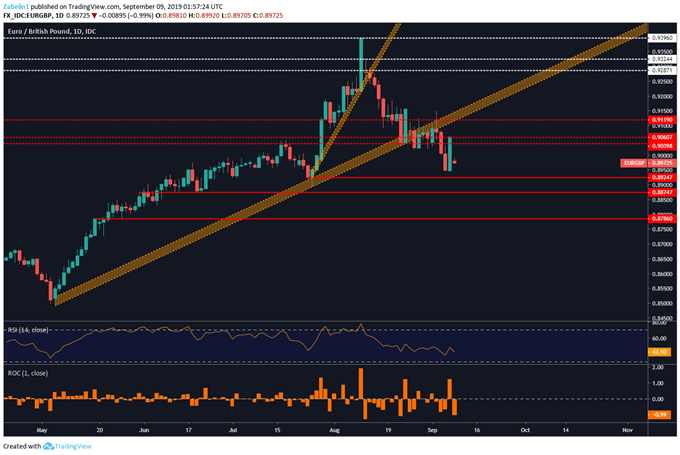
EUR/GBP is now trading below a key support-now-turned resistance level and could stay within a congestive range between 0.8974-0.9039. The pair have already broken through several key support channels and barriers and could be gearing up to clear more if momentum is maintained. However, political volatility from Brexit and the ECB rate decision this week may distort the technical set up.
EUR/GBP – Daily Chart
EUR/GBP chart showing
EUR/GBP chart 

                      Start Trading now with free $30 


                       Trading bonus. bonus up to $5000 


you can start trading without actually investing your own                         money or making a deposit.


Thursday, September 5, 2019

Gold Price and Silver Outlook: Too High to Buy, Too Strong to Short

GOLD & SILVER PRICE TECHNICAL OUTLOOK:

  • Gold momentum stalling at long-term resistance
  • Silver overbought and in need of a correction
GOLD MOMENTUM STALLING AT LONG-TERM RESISTANCE
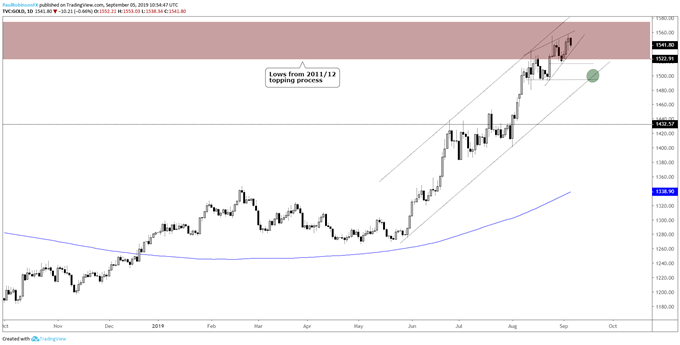
During the first half of last month gold extended into the long-term resistance zone (1522/75) created during the 2011/12 topping process. Since then it has struggled to climb much higher in a sustainable manner. This is anticipated to remain the case in the near-term, with rallies as seen as likely to continuing to fade.
An actual pullback would be a good thing for not only alleviating overbought conditions, but also allowing would-be dip-buyers an opportunity to enter at better prices. Horizontal movement, or a 'time correction', would also be a bullish alternative, but will need, well, time for this to run its course.
From a short-term tactical standpoint, shorts aren’t yet appealing despite overbought conditions into resistance. The reason being is any correction which unfolds may be a bit of a grind sideways to lower as often times corrections tend to unfold in this manner in strong trends.
The first spot to watch as support is the lower parallel rising up from May. Should that fail to hold as support near 1500, then a larger correction towards the mid-1400s may develop. Even if gold falls that far, it wouldn’t do any real damage the move higher over the past year.

GOLD PRICE DAILY CHART (MOMENTUM STALLING AT LONG-TERM RESISTANCE)

Gold Price and Silver Outlook: Too High to Buy, Too Strong to Short
Gold Price Chart 

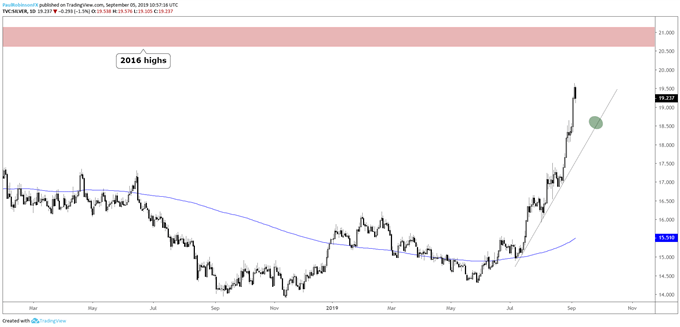
SILVER DAILY CHART (HAS SHORT AND LONG-TERM SUPPORT LINES)

Silver has gone parabolic as of late, making up lost ground compared to gold in recent years. This has led to overbought, overly bullish conditions. There aren’t any great price levels as resistance until you get up to around 20.70/21+, but this doesn’t mean it won’t correct ahead of those levels.
Tactically, shorting here doesn’t hold much appeal, but neither does entering fresh longs. Sort of stuck in a ‘too high to buy, too strong to short’ phase at the moment.

SILVER DAILY CHART (VERY EXTENDED)

Gold Price and Silver Outlook: Too High to Buy, Too Strong to Short

                    Start Trading now with free $30 


                       Trading bonus. bonus up to $5000 


you can start trading without actually investing your own                         money or making a deposit.


Thursday, August 15, 2019

US Dollar and Yen May Rise on Japan, South Korea Trade War

TRADE WARS, US DOLLAR, JAPANESE YEN, KOREAN WON – TALKING POINTS

  • US Dollar and Yen may rise if Japan, South Korea trade war fuels demand for anti-risk assets
  • Weakness in the Korean Won may be mitigated by fiscal and monetary policy FX intervention
  • USD/JPY may extend declines on long-term technical bearish pattern as USD/KRW wobbles
JAPAN, SOUTH KOREA TRADE WAR
Japan and South Korean trade relations over the past two months have soured as the conflict threatens to disrupt a critical node in the global tech supply chain, potentially benefiting the US Dollar. The origin of the dispute – much like other issues the world is being afflicted by – is political. The underlying source of tensions between the two dates back to Japan’s occupation of Korea during World War II.
Last year, the South Korean Supreme Court ruled that several Japanese companies had to compensate the victims wartime forced labor victims. Tokyo responded that restitution had already been paid through an agreement made in 1965. Amid this dispute, on July 1, Japan restricted the export of hydrogen fluoride gas, fluorinated polyimide and photoresists – all key chemical inputs used to make semiconductors, flat screens and other high-tech products.
Officials in Tokyo cited national security grounds behind their decision to restrict the sale of these key inputs because they can also be used in military hardware. Japan expressed concern that unspecified South Korean companies may have allowed North Korea to access some of these chemicals. Seoul has denied the accusation, though this appears to not have convinced Japan.
Japanese companies will now have to deal with more paperwork and a lengthy permit application process which could cause delays and threaten to disrupt a critical tech supply chain. South Korea is the biggest manufacturer of dynamic random-access memory (DRAM) semiconductors in the world, and home to Samsung and SK Hynix, two key producers of critical inputs used in high-tech hardware.
South Korea Kospi Index Overlaid with Samsung, SK Hynix
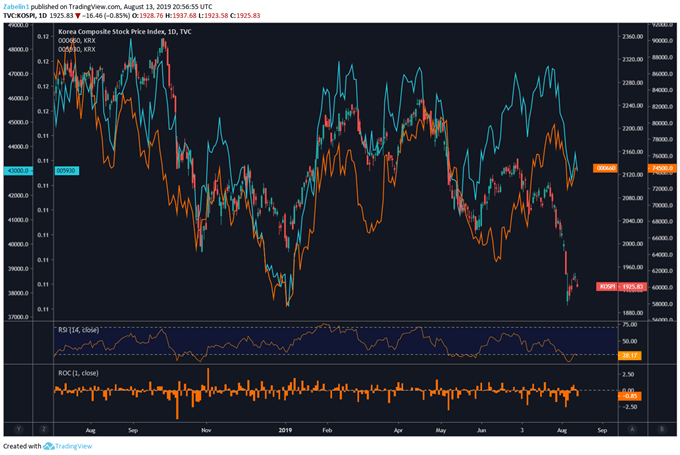
Chart Showibng KOSPI Index
Kospi chart   South Korea also recently announced that it is dropping Japan from its white list of trade partners that allows for “fast-track trade status” after Japan pulled a similar lever earlier this month. Both countries are already struggling with slower Chinese growth amid Beijing’s trade war with the US. A bilateral deterioration between Seoul and Tokyo could hamper regional growth which may ripple out and affect global financial markets.
Both sides appear to be digging in their heels as South Korean officials state that they will not be “defeated again” by Japan. Broadly speaking, the tiff appears to reflect political contagion following the US’ recent willingness to sidestep international trade dispute resolution mechanisms through multilateral institutions like the WTO. This has created an environment where – to quote Joseph Stiglitz – almost “everything is acceptable, and no one is accountable.”
Looking ahead, the US will probably have to help reconcile the historical wounds between the two and prevent further deterioration in light of North Korea’s more aggressive display of military might. However, Seoul and Tokyo are both facing an unpredictable administration that is working to mediate their dust-up even as it undermines each country’s growth prospects with its tariff-based approach to regional commerce.

IMPACT ON US DOLLAR, JAPANESE YEN AND KOREAN WON

So far this year, amidst trade wars and in spite of rising expectations of easing by the Federal Reserve, the US Dollar has by and large outperformed against its major counterparts. This likely owes to its status as a safe-haven currency, thanks to its unrivaled liquidity. If tensions between Japan and South Korea undermine global growth prospects, USD may continue to outperform.
This is also what the anti-risk Japanese Yen could be facing if a premium for preserving capital arises. The Bank of Japan is in cruise-control mode, supporting an economy suffering from anemic price growth. Low inflation works to maintain the value of Yen over time. This makes it a prime candidate as a funding currency in carry trades. When risk aversion kicks in and yield-seeking carry exposure is unwound, the buying back of JPY tends to boost it.
As for the Korean Won and the vulnerabilities it faces if tensions between Tokyo and Seoul escalate, there may be a chance that declines only go so far. That is because earlier this month, South Korean Finance Minister Hong Nam-ki said that the government will make an “all out” effort to stabilize markets. This also includes taking preemptive steps in the event of FX instability.
On top of this, Bank of Korea (BOK) Governor Lee Ju-yeol said that the central bank could cooperate with the government, making for strong fiscal and monetary policy intervening efforts. The KRW has already been facing selling pressure as the BOK delivered an interest rate cut from 1.75% to 1.50% in July. The central bank has mentioned that it is closely watching Japan’s export restrictions.
USD/JPY TECHNICAL ANALYSIS
In the medium-term, USD/JPY could face a resumption of the dominant downtrend going back to 2015 as outlined in the third quarter technical forecast. The currency pair took out rising support from 2016, eyeing the January “flash crash” low. Near-term signals point to corrective gains with positive RSI divergenceshowing fading momentum to the downside. Resistance appears to be a range between 106.78 and 107.21.
USD/JPY Daily Chart
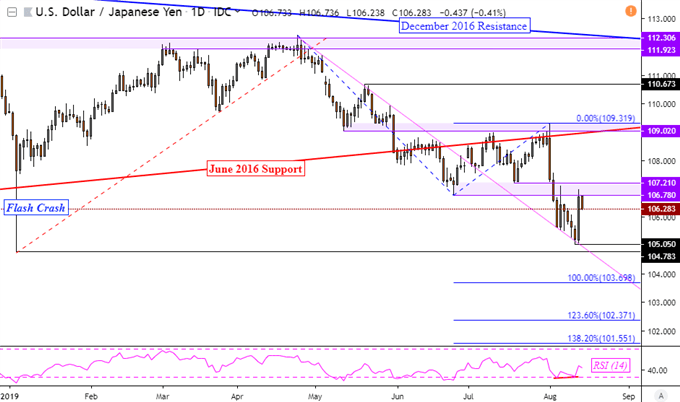
Chart Showing USDJPY
USD/JPY Chart Created in TradingView
USD/KRW Technical Analysis
Meanwhile, the USD/KRW is struggling to extend its uptrend from the end of June after support was established between 1148.90 and 1152.50. Negative RSI divergence does show fading upside momentum as resistance holds between 1215.91 and 1223.46. A turn lower places support as the rising trend line from July, Otherwise, clearing resistance exposes highs from February 2016 around 1244.30.
USD/KRW Daily Chart
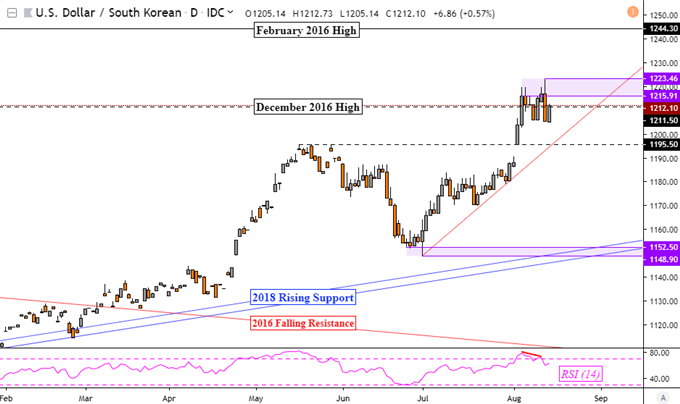
Chart Showing USDKRW
USD/KRW Chart

Sunday, July 14, 2019

Asian Markets Rise On China Relief Despite 27-Year Low GDP Gains

ASIAN STOCKS TALKING POINTS:

  • Chinese stock market gains as players looked past wholly expected weaker growth
  • There were brighter spots in June’s economic release
  • The US Dollar was broadly lower with something of a relief rally seen for its Australian cousin
Asian stock markets managed gains despite the deceleration of Chinese growth to its slowest for 27 years.
Official second quarter Gross Domestic Product expanded by 6.2% compared to the same period. This was exactly as forecast, limiting any ‘shock value.’ There was also some relief in data released at the same time showing stronger than expected gains for retail sales, industrial production and fixed asset investment for the month of June.
There remain dark clouds over the Chinese economy. Trade problems with the US are unresolved, manufacturing is contracting while inflation is rising, and the authorities will not want to further stoke already vast corporate debts with lower borrowing costs. Still, markets took Monday’s numbers overall as an upside surprise, with equities up 0.8% in the middle of the Shanghai afternoon. Hong Kong’s Hang Seng had added 0.2% while the ASX 200 was down 0.4%. Wealth manager AMP’s shares fell more than 15% after the company reportedly called a sale of its life insurance business ‘highly unlikely.’ Japanese markets were closed for a holiday break.
The US Dollar held near ten-day lows against a basket of its most widely traded rivals. The foreign exchange market seems pretty sure that US interest rates will be heading lower soon. The Australian Dollar meanwhile made gains in the wake of that Chinese growth news and managed to build on them through the session.
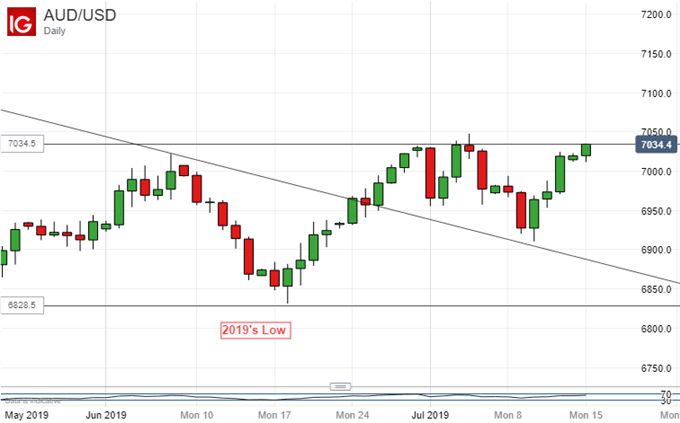
AUDUSD bulls have managed to keep the bounce from 2019 lows seen in mid-June very much alive.
Austalian Dollar Vs US Dollar
The pair is now threatening to top its previous significant peak, despite just having endured the first back-to-back monthly interest rate cuts since 2012. For the moment the US Dollar seems to be driving most of the action here, and focus will probably return to the Aussie’s own lack of interest rate support soon enough. All the same, there may be less scope for still-lower Australian borrowing costs in the coming months than the market thinks.
The rest of the global session won’t offer markets much of huge interest, with Tuesday’s US retail sales figures probably the next major hurdle for investors.

                               Start Trading now with free $30 


                       Trading bonus. bonus up to $5000 


you can start trading without actually investing your own money or making a deposit.


Friday, February 22, 2019

US Dollar Bounce at Support Keeps Near-term Outlook ’Neutral’

Talking Points
- EU officials continue to insist that no changes can be made to the Withdrawal Agreement, but it is possible for a three-month extension of the Brexit window into the end of June.
- American and Chinese trade negotiators aren’t expected to reach a major breakthrough, but the March deadline for the bump in tariffs could be avoided anyway.
The US Dollar (via the DXY Index) has seen its losses halted following doji candles that appeared midweek, although gains are proving difficult to hold onto. Meaningful US economic data have been few and far between this week, but those data that did arrive have showed that the US economy may have indeed lost momentum early in Q1’19 (perhaps due to the government shutdown). Otherwise, traders continue to grapple with the implications of the January FOMC meeting minutes.

BREXIT EXTENSION AROUND THE CORNER?

Across the pond, the EU-UK Brexit negotiations remain at an impasse, with the UK government looking for additional assurances regarding the Irish border backstop and the EU saying that the Withdrawal Agreement can’t be renegotiated. This game of chicken is likely to continue as neither side wants to see the UK crash out of the EU without a deal. Accordingly, we’ve now arrived at the juncture where officials on both sides are openly talking about a three-month extension to the negotiation window beyond March 29.
This is not a surprise. As we’ve explained before, an extension to the negotiation window was a distinct possibility, as was the duration of the extension. Why? In early-July 2019, new MEPs will be elected. It makes sense, from the EU’s perspective, to cleave the relationship with the UK beforehand. Otherwise, if the UK is able to send MEPs to the new European Parliament, it’s not much of a Brexit at all, is it?

US-CHINA TRADE TALKS MAY NOT PRODUCE MUCH

Chinese Vice Premier Liu Hi is in Washington, D.C. meeting with US Treasury Secretary Steve Mnuchin and US Trade Representative Robert Lighthizer for a seventh round of trade talks in order to avoid the not “magical” (US President Trump’s words) March 1 deadline for a deal. Otherwise, without a deal, the 10% tariff on $200 billion of imported Chinese goods will evolve into a 25% tariff on March 2.
Early signs from the talks indicate that not much progress is being made. But what little that is being accomplished may simply be laying the ground work to push off the implementation of the higher tariffs on March 2, rather than a sincere effort at resolving the problems in totality. After all, a summit between US President Trump and Chinese President Xi Jingping is required before a deal can be signed, sealed, and delivered – and no summit date has been set yet.

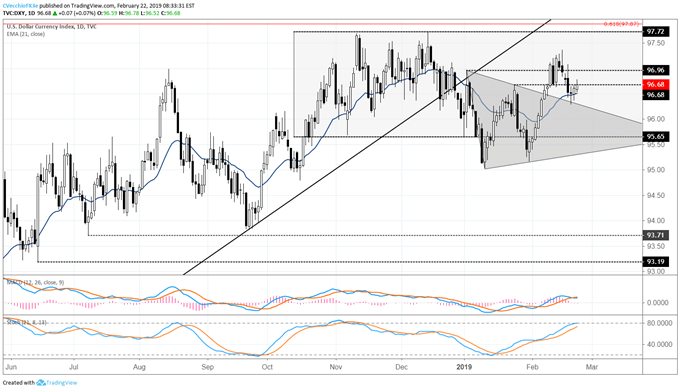
DXY INDEX PRICE CHART: DAILY TIMEFRAME (JUNE 2018 TO FEBRUARY 2019) (CHART 1)

US Dollar Bounce at Support Keeps Near-term Outlook 'Neutral'
When we commented on the DXY Index technical situation yesterday, price was in the midst of forming an inside day doji candle – a second consecutive doji candle at that. Coming off of a selloff from Friday’s high (as well as the yearly high), the implication was that the near-term outlook was neutral. By the end of the day yesterday, the inside day doji had become an inside day hammer – raising the odds of a near-term low having been established.
In what doesn’t appear to be a coincidence, this week’s lows come back at the retest of the symmetrical triangle resistance, now support in the breakout attempt. To this end, the daily 21-EMA, despite being test, held up on a closing basis as support as well. It thus still holds that a return back into the symmetrical triangle (below 96.30 by the end of this week) is necessary to constitute a shift to a fully bearish point of view in the short-term

Gold Price Consolidates Further, Chart Remains Positive

GOLD (XAU) PRICE, NEWS AND CHART:

  • Gold slips as market grab a risk-on bid.
  • Higher highs and lows dominate the Gold chart.
Gold’s sell-off from Wednesday’s 10-month high remains intact as financial markets continue to trade with a risk-on bias, boosted by US-China trade hopes, while a resilient US dollar weighs on the precious metal. The mid-week sell-off may have room to extend further but the Gold chart remains positive and is likely to find support shortly before it prepares to make a fresh attempt at the January 2018 high at $1,366/oz.
Gold is currently heading towards its weekly low around $1,320/oz. although today’s price action is muted. The medium-term outlook for Gold remains positive with a series of higher highs and higher lows confirming the upward trend. The RSI indicator has reversed out of overbought territory, as it has done twice before this year, but sentiment remains positive. Below this week’s low, the 20-day moving average may provide support around $1,318/oz. ahead of the current monthly low around $1,302/oz. If the pattern of moving higher, becoming overbought and then consolidating repeats itself for a third time this year, the latest downturn in the precious metal may prove to be short-lived.
GOLD DAILY PRICE CHART (MAY 2018 – FEBRUARY 22, 2019)
Gold Price Consolidates Further, Chart Remains Positive

Thursday, February 21, 2019

US Dollar Selloff Hits Pause as Back-to-Back Dojis Materialize

Talking Points
- The US-China trade negotiations are front-and-center once more, with Chinese Vice Premier Liu He in Washington, D.C. to meet with US Treasury Secretary Steve Mnuchin and US Trade Representative Robert Lighthizer.
The calamity unfolding in UK parliament may actually be the reason why the British Pound is staying afloat.
The US Dollar (via the DXY Index) is treading water for the second straight day, with traders lacking concrete catalysts in the near-term to help divine the next major move. Back-to-back dojis on the daily chart speak to this state of indecision, and the lack of significant economic developments out of the United States this week may be contributing to the state of trance. The greenback appears to be waiting to take cues from other asset classes, as both US equtiy markets and Gold prices are pulling back after their recent extended rallies.
Brexit Latest – Defections Help Buoy Sterling
As the February 26 (UK parliament takes control) and March 29 (UK leaves EU) deadlines approach, the growing number of departures from both the Labour and Tory parties into a new, pro-Remain political party, “The Independent Group,” is a sign that a no deal, “hard Brexit” might be avoided. After all, UK PM Theresa May’s hold on power is proving increasingly tenuous, now that her majority in parliament is down to a skinny eight votes. Paradoxically, the more defections that take place, the greater the likelihood that the UK will have to push back its Brexit deadline and pursue other options, like a general election or second refernedum, instead.
Seventh Round of US-China Trade Talks Begin
The economic calendar has been quiet this week for the US, outside of a few housing market releases and the January FOMC meeting minutes. Stepping into this void is the next round of US-China trade war negotiations taking place in Washington, D.C. Chinese Vice Premier Liu Hi is meeting with US Treasury Secretary Steve Mnuchin and US Trade Representative Robert Lighthizer, and it’s possible that the groundwork is being laid to avoid the early-March deadline.
After all, US President Donald Trump said that the deadline wasn’t “magical,” raising hopes that the negotiation window could be extended without the trade war intensifying. Otherwise, without a deal, the 10% tariff on $200 billion of imported Chinese goods will evolve into a 25% tariff on March 2.
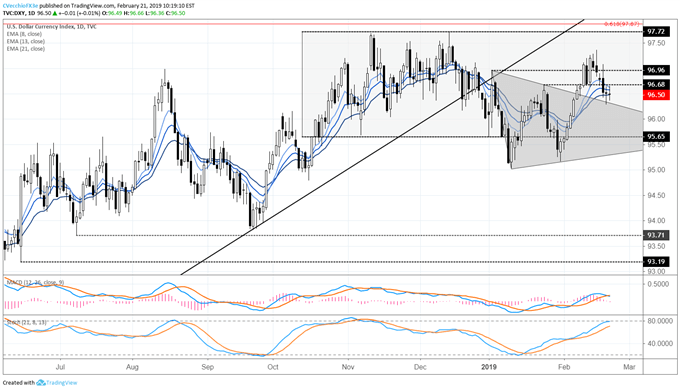
DXY Index Price Chart: Daily Timeframe (June 2018 to February 2019) (Chart 1)
US Dollar Selloff Hits Pause as Back-to-Back Dojis Materialize
After seeing bearish outside engulfing bars develop between last Friday and Tuesday, any near-term bullish view was negated earlier this week. There’s little reason thus far to think that the near-term outlook is anything other than neutral at present time. A doji candle yesterday hinted at the state of indecision, and the inside day doji forming today compounds the state of turbidity. It thus still holds that a return back into the symmetrical triangle (below 96.30 by the end of this week) is necessary to constitute a shift to a fully bearish point of view in the short-term.